Showing posts with label environmental issues. Show all posts

Wednesday, May 7, 2008

Dredge it and they will come? Plan hatched to help Niger River

Since the early 1980s, the Niger River has experienced a 55 percent decrease in flow, driving down fish stocks and making navigation difficult. Scientists blame that on industrial waste, increasing population demands and climate change.

As Africa’s third largest river, where nearly 110 million people live in its basin, the mighty Niger begins in tropical Guinea and snakes through Sahelien Mali, desert-like Niger and arid and coastal Nigeria. Its health also affects populations in Burkina Faso, Cote d’Ivoire, Chad and Cameroon. The onset of desertification has seriously influenced the Sahelian states and has also contributed to the lower stream flow.

Last month, nine countries that live on the 4,200 km basin hatched an $8 billion, 20-year plan to help restore a little life in the Niger. They will do so with a series of reforesting plans, projects to rehab the plains abutting the river and dredging silt from the river bed. Constructing hydro-electric dams have also been included in the program as well as transport and river fishing regulations.

Funds, you ask? Yeah, the nine governments have secured nearly one-fifth of the total budget. The Islamic Development Bank has promised to build two dams – one in Niger and the second in Mali. For the rest, the countries hope to raise a large portion of the funds at a donor’s conference in June. Mark you calendars.

Friday, April 25, 2008

What can Africa learn from Brazil’s resource management techniques?

File this under: Peripheral issues of rising food costs. In Brazil, where we’ve long heard tales of falling Amazon trees to make room for lumbering, gassy cows, but now environmental groups are teaming up with farmers and rancher types to create certification systems for eco-sponsible soy and beef production. The argument: If farmers can make money becoming eco-friendly, they’ll have more incentive to be eco-friendly.

There’s a long-standing debate within environmental groups on how much voice to give business interests. In this story, however, the argument goes that giving ranchers a seat at the table will insure that environmental laws could be better followed.

The same goes for logging companies. One of the issues facing Brazil is that many of its forests are privately owned, making environmental laws difficult to enforce. Brazil’s President Luiz Inacio Lula da Silva offered land concessions to timber companies promising to practice proper forest management on the country’s still substantial public forests. It’s an important – and forward thinking – step because world timber demand is projected to remain high, making the depth and breadth of the Amazon basin looking increasingly attractive for timber concerns everywhere. Setting the foundation for proper forest management could make things easier in the long run.

Similar issues are affecting Benin. (See, I told you.) The World Rainforest Movement – viewpoint: “Community-Based Forest Management is not Only Possible it is Essential” – argues the country’s growing population has driven up demand for arable land. One village sitting within the lgbodja region has made available 5,000 hectares to initiate forest management. That, along with hedgehog breeding and bee keeping, may provide alternative economic activities that will keep villagers from cutting down more trees to plant crops. The plan is to move to other villages in the area. Another worry is that non-local farmers have been encroaching on the forest land, cutting trees to plant. As tenants, these roving farmers cannot plant trees. Conflict could be alleviated if the tenants are also given a stake in matters.

In Cameroon, we can see the counter-factual. (What happens when nothing is done?) Rapid forest degradation can be blamed on industrial logging without any national or local oversight. Environmental groups blame the government which looks the other way as industrial logging companies use a free hand over the land. The end result: Cameroon is Africa’s leading timber exporter with little affect seen in the country’s GDP.

Not so fast, says a World Bank report. Slash-and-burn agriculture and fuel wood demand could be responsible for up to 90 percent of the country’s deforestation. But really, the report goes on to say, they are secondary effects of tropical timber harvesting. The issue is that timber industry activities are closely linked to happenings in the agriculture sector – which must deal with growing population and low productivity – and the political economy: namely, a lack of commitment to reform from the government, especially the executive branch; opposition to reform from key actors – foreign logging companies and Parliament – and, taking these issues into account, failure by actors to devise a compatible forest strategy outside of “give it all away for whiskey and prostitutes.” (I made that last part up.)

Wednesday, March 12, 2008

West Africa's diverse forests now relegated to an historical footnote

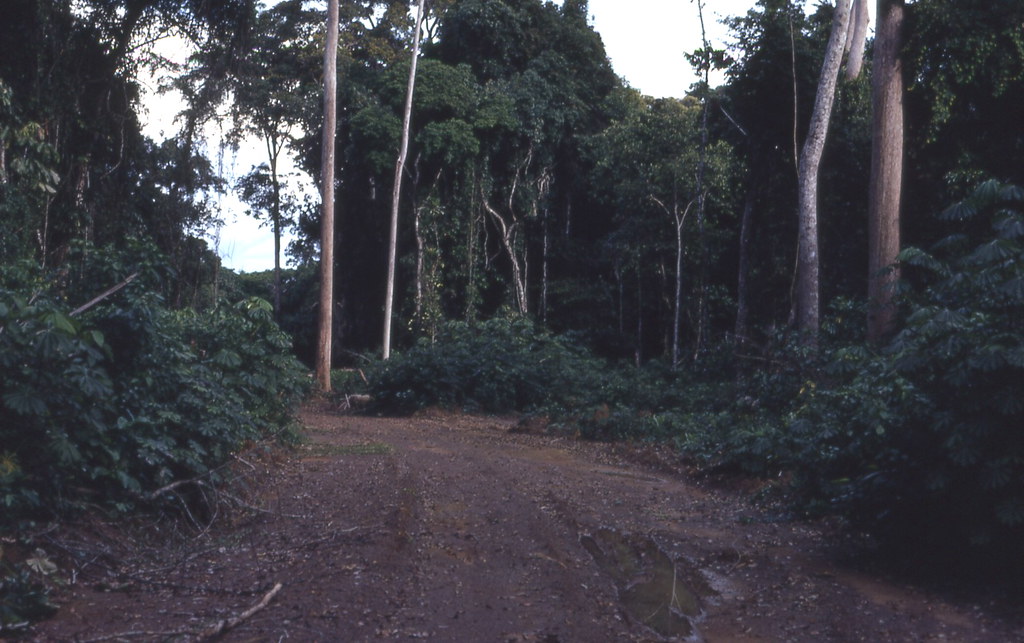
Photo by gbaku
Trees on logging road near Konimbo, Liberia in May, 1968

We’re late on this, but…. AfricanLoft has a multi-media piece on the state of Africa’s rainforest. The short of it: The band of tropical forests that once extended from Guinea to Cameroon is now a footnote, argues Mongabay.com.

This band is called the Guinean Forest, and is known as a biodiversity hotspot, home to 9,000 vascular plant species, 785 bird species and an estimated 320 species of mammals, representing more than 25 percent of all the mammals in Africa. Hey, primate lovers, the region is home to 18 species of primates. And, reptiles too: A 100 species of snakes and all three types of African crocodiles all live within these boundaries.

The bulk of Africa’s forests now reside south of Cameroon, especially in the basin of the mighty Congo River.

From AfricanLoft:

There are a variety of causes for the diminishing forest in Africa - sustenance farming and infrastructure and real estate development, but the major culprit has always been the foreign corporations’ indiscriminate and excessive logging for African prime wood. This quest to export African timber is been aided by poverty, top level corruption, regional warfare, and misplaced priorities of African governments.


Tuesday, February 19, 2008

The EU's fishy politics off the coast of Mauritania

From Reuters:

The European Union will renegotiate a fishing deal this month with Mauritania, its most valuable such agreement, and seek to pay the country less compensation due to the lower amounts of fish it takes.

The EU has signed more than 20 bilateral fishing agreements, nearly all with developing countries and mostly in Africa, that give the bloc a substantial extra supply of fish.

The deal with Mauritania is the largest and most valuable to EU countries, allowing 200 boats flying the flags of some 13 EU nations to catch many species in Mauritanian waters.

For that, the EU pays Mauritania 86 million euros ($125.8 million) a year, an arrangement that represents almost a third of Mauritania's national revenue.

Since the EU is not using all its fishing quota allowances, experts at the European Commission's fisheries unit want to lower them -- and pay less from EU coffers. After the two sides signed a memorandum of understanding last month that they would renegotiate terms, those talks should resume in late February.

However, the Commission aims to keep the overall value of the Mauritania deal unchanged since the Commission's development unit would probably step in to pay the balance, diplomats say.

But the European fishing industry is not as cut-and-dry as you’d expect.

From the Wall Street Journal, through Yale Global Online.

Wealthy countries subsidize their commercial fishermen to the tune of about $30 billion a year. Their goal is to keep their fishermen on the water. China, for example, provides $2 billion a year in fuel subsidies; the European Union and its member nations provide more than $7 billion of subsidies a year. Such policies boost the number of working boats, increase the global catch and drive down fish prices. That makes it more difficult for fishermen in poor nations like Mauritania, who get no subsidies, to compete.

The end result: African waters are losing fish stock rapidly, with ramifications both to the economies of Africa's coastal nations and to the world's ocean ecology. Over the past three decades, the amount of fish in West African waters has declined by up to 50%, according to Daniel Pauly, a researcher at the University of British Columbia.

Boats for Migration

On Africa's coast, thousands of fishermen have been put out of work. Some have been using their boats to try to migrate illegally to Europe. The economic effect extends beyond fishermen to the many women who sell fish in markets in coastal communities.

Shifting global dietary patterns are partly to blame. A booming world-wide appetite for seafood has lifted the fishing industry's global production to record levels. Total fish trade grew to $71.5 billion in 2004, up nearly 25% from 2000, according to the Rome-based Food and Agriculture Organization, or FAO, an office of the United Nations. "There are too many boats chasing too few fish," says Grímur Valdimarsson, director of the FAO's fisheries division.

Monday, January 28, 2008

In Africa, everyone is home, but the lights are out

How important is it to have electricity in your home in Africa? It’s a convenience, yes, but would it help increase development? Most day-to-day living takes place out of doors (even in places like Ouagadougou), and heat is not really an issue in West Africa. Fans, of course, help. But are refrigerators a necessity? Meats and other food could be stored for longer periods of time without being covered by bacteria-carrying flies. How important are lights in a country where the sun goes down around 6 pm every night? You could make the argument it would be better for school kids who often have to sit under street lights to read past dark.

People have learned to cope, of course. People drink in bars with electricity in order to plug in and charge their cell phones. Televisions run on car batteries. So do small fluorescent lights. Cooking can be done on bottled gas and, in a less sustainable fashion, wood. Of course, this is very time consuming to collect, and often remains the responsibility of young girls who miss school for the pleasure of fulfilling this chore.

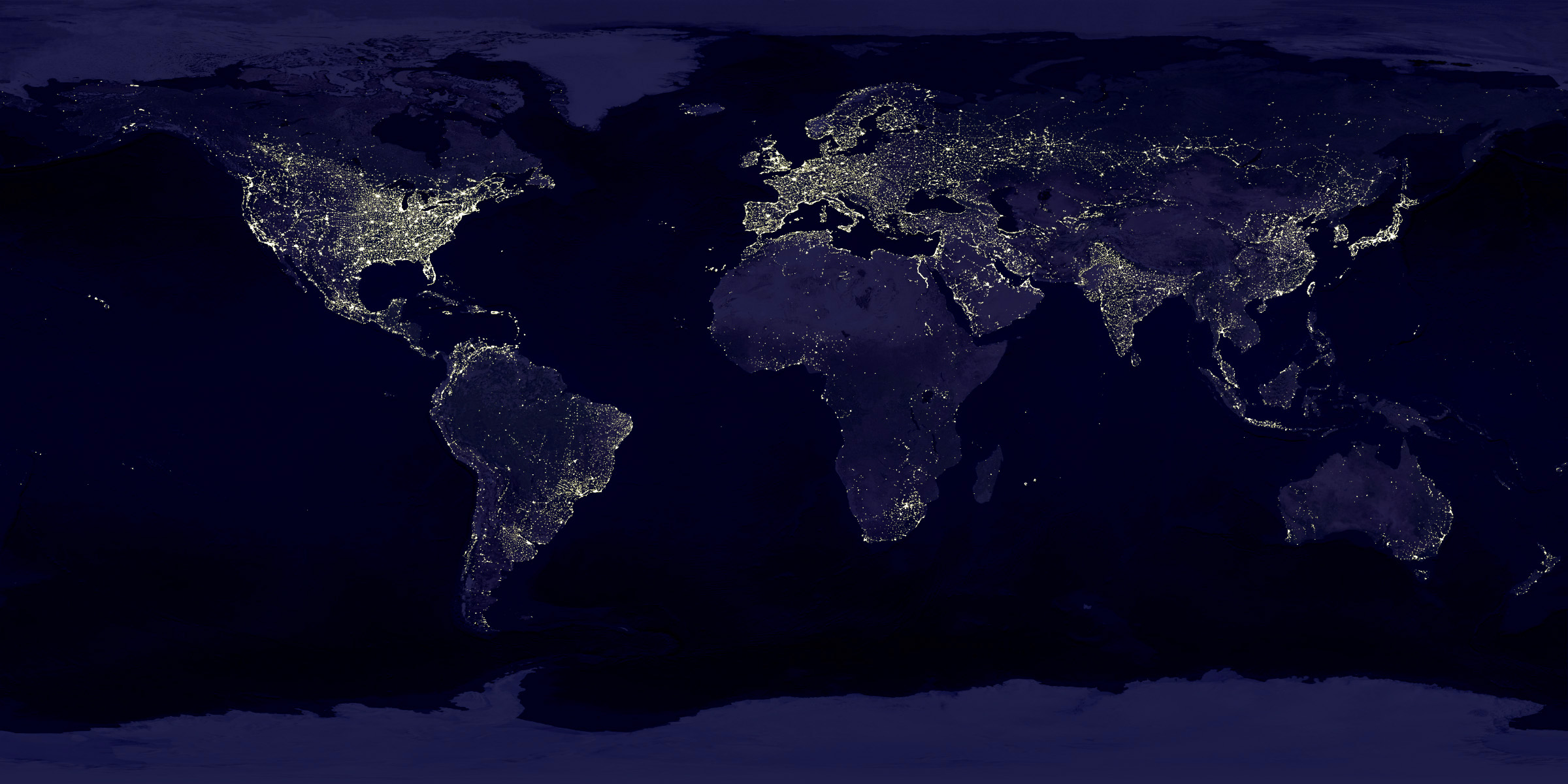
Regardless of how people feel on the development debate, the lights are mostly out across Africa. This map will show you. On average, only five percent of Africa’s population enjoys access to electricity. In rural areas, that number drops to about 2 percent.

A growing necessity
What may be seen as a luxury for home, electricity is a necessity for businesses. Machines or equipment can’t run without a current; nor can computers or lights. Cell phones won’t get charged.

What’s worrisome for entrepreneurs is not the lack of electricity, but an unstable electrical supply. When electricity is depended on, entrepreneurs embark in dangerous territory when the supply is cut or inconsistent. Stock could spoil; surges could damage machines; the workforce may be sent home without pay. The problem is that much of the continent’s manufacturing sector works in urban areas, and inconsistent electrical supplies in cities have become the norm. Growing metro regions sap a country’s electrical capability.

But in rural areas, where the possibilities of work outside of agriculture are minimal, a lack of electricity remains problem number one. Here is a good overview of small energy cooperatives making and selling power to everyday folks in rural Mali and Burkina Faso.

Resources, what resources?
On the macro level, however, Africa possesses enough resources to meet all its energy needs. Oil is a well known commodity. The continent’s fertile river systems – the Nile in the north, the Zambezi and Congo in the South and the Volta and Niger in West Africa – could easily be tapped for power. “The hydro potential of the Democratic Republic of Congo alone is estimated to be sufficient to provide three times as much power as Africa currently consumes,” writes Itai Madamombe in Africa Renewal, a UN-sponsored magazine.

West African energy production and consumption is a tale of the haves – Nigeria, Ghana, Cote d’Ivoire – and the have nots – Burkina Faso, Mali and Niger. For those three relatively poor Sahelian countries, located far from coastal energy producers, electricity is definitely viewed as a luxury. (My neighborhood not included.)

The problem appears to be two fold. Costs, for one: electricity in import countries like Burkina Faso and Mali can be prohibitively expensive for most people; Secondly, the reach of electrical utilities is low because of old power plants and aging equipment. This is a problem the entire sub-region and the rest of the continent, writes Madamombe in Africa Renewal:

The bulk of power plants and transmission facilities were built in the 1950s and 1960s. Little investment and maintenance has left the infrastructure creaking at the seams. Nigeria, a prime example, operates at one-third of its installed capacity due to aging equipment.

Times are changing, however. This recent report (cited above) on Independent Power Producers claims that people are willing to pay for electricity, but cannot receive it because of the limited reach of public utilities. The reach of these IPPs is, by definition, very limited: perhaps 50 to a couple hundred houses receiving energy. But their importance is staggering.

The writers have found that these local power supplies are, in fact, cheaper than using other forms of power. In the examples of Mali and Burkina Faso, running a single appliance costs around 1,500 CFA ($3.33) per month, cheaper than car batteries, which must be charged every three or four days, totaling nearly 4,000 CFA ($8.90) per month. (Car batteries also have a finite life span.)

Electricity Integration
Cote d’Ivoire, which already exports electricity to Togo, Benin and Burkina Faso, recently announced the creation of 500 km worth of power lines through the northern part of the country to Mali, where it will export 200 megawatts of electricity. The move is seen as a positive step not only for southern Mali’s development, but also for Cote d’Ivoire because the country was recently divided in two due to a prolonged civil war.

One problem facing the electricity project, which should be complete in 2010, is that Cote d’Ivoire itself is undergoing an expansion of its power grid at a time when consumption appears to be increasing faster than production. Cote d’Ivoire has long used gas-fired plants and dams to create power, but with the country’s consumption already increasing six or seven percent per year, blackouts like those witnessed in 2007 may become more common.

The Cote d’Ivoire-Mali project is part of a regional plan called the West African Power Pool, created in 2000 by the 15 ECOWAS-member states, that strives to increase power production and energy integration, allowing electricity to move freely across borders. This would allow countries to pool technical and mechanical resources and diversify everyone’s energy supplies. And, of course, hopefully bring down energy prices.

WAPP is also researching renewable energy sources, like wind, solar and biofuels.

$150 for Electric Company and Water Works?
One constant in West African power sectors is that the state remains a major player. Only Cape Verde and Cote d’Ivoire have portions of their sectors owned by foreign private companies, according to this report. And only Benin, Togo and Ghana allow independent distribution companies. (Presently, five countries permit IPPs: Burkina, Cote d’Ivoire, Ghana, Nigeria and Senegal.)

In a paper for the World Bank, a researcher argues the high rate of state ownership in West African public utilities takes away the profit motive to improve performance and “is liable to result in the excessive costs, low service quality, poor investment decisions, and lack of innovation in supplying customers in these markets.”

For governments that run their energy sectors, the only method to bring down electricity prices is by increasing user subsidies, never a popular method with World Bankers. The better way, researchers claim, is to allow private firms search out new markets they’ll find profitable, passing along savings to their customers. However, this group of researchers found that increased privatization in the energy sector has brought on greater rates of electrification for the poor, who often reside in rural areas. (The authors, Stephen Karekezi and John Kimani, argue electricity rates to the poor should drive the argument on the efficacy of reform.)

In defense of the World Bank paper, the author, John E. Besant-Jones, is less sanguine than you'd expect about developing countries jumping directly into reform. That’s because the power sector is unlike other areas of Bretton Woods-sponsored state retrenchment: Education and public health. One, the power sector is very complex, making highly technical specialists necessary; secondly, building new infrastructure requires a very large influx of cash. These reasons have led to failures (especially in the form of higher prices) when West African states have attempted to radically reform their energy sector.

Back to development
Because energy is so important for economic development, it is seen as a pre-requisite to lift many in Africa out of poverty. This is especially true for those who live in rural areas.

Presently, fossil fuels presently provide much of Africa’s energy consumption. Like Western countries, Africa needs to begin searching alternatives.

According to a speech at a workshop titled "Electricity Access and Development Challenge in Africa,” improved energy access will free up women’s time, reduce air pollution by moving away from burning charcoal and wood for cooking, thus improving health. (Girls not needed for collecting wood may find their ways back in the classroom.) Medical care will also be revolutionized, especially for maternal care, drug storage and increased sterilization.

For economic benefits, Africans could begin processing some of their many natural products – shea butter, cotton, palm oil, etc – that are made elsewhere to high profit margins.

Benin: Rising sea waters threaten property and jobs

“Huge breakers constantly battering Benin's coast - and the rest of the shoreline on the Gulf of Guinea - are starting to take their toll,” writes South Africa’s IOL. “Ivory Coast, Ghana, Togo and Nigeria are also fighting to stop the sea from gulping up chunks of land.”

The erosion to Benin’s coastline is staggering. East of Cotonou, since the country’s independence from France in 1960, the beach has retreated some 400 meters, claims a member of the UN Environmental Program. The encroachment of water affects properties along the beach in obvious physical ways, but subtle effects are now seen. For example, fishermen now experience problems getting their boats through the incoming rush of tide.

The story refers to a study from Columbia University (which I can’t find) that estimates sea water levels could rise nearly 50 centimeters by the end of the century. Newly minted Nobel Peace laureates, the Intergovernmental Panel on Climate Change, says sea levels could rise between 20 and 60 cm in that time period.

But these predictions due to Global Warming are not the only problem exacerbating issues facing West Africa’s coast. Local human activities can also be blamed. The construction of two massive dams, one in Benin and one in Ghana, on rivers near the coasts send discharge far into the ocean that is usually meant to stabilize the shoreline. People make cement by using beach sand – more than one million cubic meters each year in Benin alone, according to IRIN. We must also take into account all the land lost from dredging the coastline to build the region’s major ports in Abidjan, Tema, Ghana, Lomé, Togo and Cotonou.

Who knows how much this has affected places like Grand Popo, a small town near Togo’s border with Benin, that now rests largely underwater. Could a big urban area like Cotonou find itself submerged?

From the IOL story:

A number of other studies have underscored just how quickly most of Cotonou, Benin's commercial capital, could disappear under the waves.

One by the French firm SOGREAH-Laboratoire DEFT said: "If nothing is done before 2025, the coastline will lie 950 metres farther inland than it did in 1963."

Hardest hit would be the section of Cotonou known as Les Ambassadeurs, which the French study said would be swallowed up completely, as would the road that links the administrative capital Porto Novo to Lagos in Nigeria. Other districts of Cotonou could follow pretty quickly, it warned.

But it was only in September that the government banned local construction companies from pumping sand from the seacoast and told them to use sand from rivers instead.

Benin's next big plan is to build dikes to protect its 125-kilometre coastline. The €50-million project financed partially by the World Bank is set to start in first half 2008.

"Our first goal, stopping the extraction of sea sand, has been achieved. We are now going to build dikes in two directions starting from Cotonou channel: towards the Togolese border and towards the Nigerian border," Urban Planning Minister Francois Noudegbessi told AFP.

UNEP experts, however, said that only a full regional dike would be beneficial, stretching at least along the five countries from Ivory Coast east to Nigeria.

Economic considerations
Its coastline brings in a good portion of Benin’s GDP. Continuing sea level rises could easily destabilize the country’s socio-economic-environmental balance: Great financial resources may have to be diverted to build dikes and other water control systems; those who rely on the water for work, like fishermen, may struggle to keep up with the great changes in their occupations; coastal villages may be forced to move inland, possibly creating land tenure issues; the loss of coastal wetlands may affect the availability of clean drinking water.

This study tries to take that all into account. By reviewing land height and population density, researchers predict that if West African coastlines rise by one meter over the next 90 years, 2.3 million people could be directly affected, costing economies as much as $3.6 billion when compared to GDP. If water levels increase by five meters, it will affect 3.3 million people and total $4.9 billion in GDP.

Monday, January 14, 2008

Teach a man to fish: overfishing off West Africa's coast

Domestic and international overfishing off the West African coast has not only ruined the livelihoods of thousands of African fishers, but also robbed the region of an important source of protein, the New York Times points out.

Debate rages over whom to blame. There are those who claim that as the European Union has moved to regulate fishing off its coasts, international concerns have moved to other, less regulated waters. The EU maintains that Europeans have become scapegoats for poor management by African governments, which have never cracked down on illegal fishing. “They argue that African officials oversell fishing rights, inflate potential catches and allow pirate vessels and local boats free rein in breeding grounds,” writes Sharon LaFraniere.

Overfishing is hardly limited to African waters. Worldwide, the United Nations Food and Agriculture Organization estimates that 75 percent of fish stocks are overfished or fished to their maximum. But in a poor region like northwest Africa, the consequences are particularly stark.

Fish are the main source of protein for much of the region, but some species are now so scarce that the poor can no longer afford them, said Pierre Failler, senior research fellow for the British Center for Economics and Management of Aquatic Resources.

The coastal stock of bottom-dwelling fish is just a quarter of what it was 25 years ago, studies show. Already, scientists say, the sea’s ecological balance has shifted as species lower on the food chain replace some above them.

In Mauritania, lobsters vanished years ago. The catch of octopus — now the most valuable species — is four-fifths of what it should be if it were not overexploited. A 2002 report by the European Commission found that the most marketable fish species off the coast of Senegal were close to collapse — essentially sliding toward extinction.

Thursday, December 20, 2007

Plus ça change du Niger: journalists arrested, human rights violations abound and blame falls on the French

Just days after Niger President Mamadou Tandja offered a fig leaf to Tauregs by assuring rebels the state would not seek reprisals if they put down their weapons, the government arrested two French journalists in connection with the conflict, Reuters says.

The country’s security forces claim the two men, both television journalists working for European TV ARTE, defied a ban on foreign reporters for the north of the country during what is being called the Second Tuareg rebellion. The journalists have been in custody since Monday.

The indigenous and formally pastoral Tuaregs claim the government is not fulfilling economic development and political requirements from the 1995 peace deal, which ended their 1990s uprising. The Niger government declares the rebel group, the Niger Movement for Justice, MNJ, does not represent the mainstream Tuareg community; rather, it is a group of smugglers and bandits.

Aid organizations have complained that because of violence and government decree, the north of Niger has largely been sealed off.

A spokesman for the Gendarmerie said the two reporters obtained accreditation to film in the southern city of Maradi. When they returned to Niamey, their tapes were searched and found to have interviews with members of the MNJ.

Niger is also holding two Nigerien journalists in custody relating to the rebellion. Moussa Kaka, local correspondent for Radio France International, has been imprisoned since Sept. 20 for allegedly aiding the MNJ. Ibrahim Diallo Manzo, a journalist for the Agadez-based Air Info, has been imprisoned since October 9.

Human Rights violations
Two international human rights organizations released the details of their investigations, decrying violations perpetrated against citizens by both sides of the conflict. Amnesty International’s report condemns the increasing number of extra-judicial executions of civilians in the northern Agadez region by the country’s military forces.

Over the past four weeks, at least thirteen civilians have been unlawfully killed by the Niger security forces in the north of the country. Some, if not all, of them were apparently killed by the army in reprisal for attacks carried out by the Tuareg armed opposition group, the Mouvement des Nigériens pour la justice (MNJ), Niger Movement for Justice, which took up arms against the government in February 2007

Human Rights Watch pointed a finger at the Tuareg rebel movement for human rights violations against citizens. HRW singles out the group’s use of anti-vehicular land mines. From the report:

Foreign military analysts interviewed by Human Rights Watch have suggested that landmine use by the rebels has recently transformed from being defensive in nature – designed to deter entry of the military into rebel bases or areas of control – to being more offensive, and intended to inflict military losses. This change in their deployment, and the subsequent increase in civilian casualties, has generated considerable fear and hardship for the civilian population.

Anti-vehicular landmines are not banned under the 1997 Mine Ban Treaty on anti-personnel mines, to which Niger is party. However, their use is still governed by the general laws of war, which prohibit the use of weapons that cannot discriminate between civilians and military targets. Placing anti-vehicular weapons on roads commonly used by both military and civilian vehicles is such an indiscriminate use. Where their use is not prohibited, particular care must be taken to minimize their indiscriminate effects.

The Areva question
One rumor that has gained traction in recent months is that the spurned French uranium firm Areva has been financially supporting the Tuareg rebellion. The firm, run by a close adviser to former French president Francois Mitterand, recently lost its 30-year monopoly on mining uranium in Niger, for which they compensated the government well below market value.

Niger, currently the world’s third largest producer of uranium, had long asked Areva to renegotiate its agreement that stipulated a price of €42 per kilo, while the world market rate has increased more than five-fold since 2001 to upwards of €180 per kilo.

The company stalled. The government recently gave nearly 90 uranium exploration permits to mining companies from a host of different countries. As oil prices keeps rising, uranium will become increasingly popular for countries wishing to dabble in nuclear energy. The International Atomic Energy Agency has argued that by 2025, global nuclear energy capacity should grow between 22 per cent and 44 per cent, increasing demand for uranium.

Tuaregs have complained that the government does not share with them enough profits from its booming uranium industry. They also criticize mining companies for not hiring enough Tuaregs living in the area and failing to address the environmental degradation created by their mines.

Things did not get off to a good start for one of the first firms to receive a mining license in northern Niger. In July, Tuareg rebels kidnapped a number of employees of the China Nuclear Engineering and Construction Corporation. The hostages were released nine days later, but afterwards the Nigerien government openly accused officials of the French mining company of supporting the rebellion movement.

Once Nicolas Sarkozy became President of France, he called President Tandja directly and tensions have eased somewhat. Since then, Areva, Niger’s largest private employer, will now pay a per kilo price of €60 through the rest of 2007. Government of Niger officials say that in 2008 the price will be negotiated again.

Pick your fights
At least one group believes the conflict between the government and the mining firm should not be viewed through the lens of the Tuareg rebellion, but framed by the larger effort of third-world countries to be fully compensated for their natural resources.

From Consultancy Africa Intelligence:

Supposedly weak, African Governments are following a route not dissimilar to the modus operandi employed in the oil and gas sectors in South American countries. Just as Venezuela, Bolivia and Colombia did in 2005 and 2006, the African Governments are trying to renegotiate natural resources contracts and adjust them to better reflect market price - a factor which is sure to drastically change the monopolistic contracts signed in the 1970’s, much to dismay of the continents ‘traditional partners’.

Time to clear the air: moto exhaust, sand and smoke fill our lungs in Ouagadougou

“The main enemy of our respiratory system is the bad quality of air we are breathing,” Professor Ouaoba Kampatileba, head of the respiratory disease department at Yalgado Ouedraogo hospital in Ouagadougou, told IRIN, the UN sponsored news service.

Ouagadougou’s poor air quality is such a problem that we can blame it on about 200 new cancer cases every year. Kampatileba estimated 15 percent of the 8,000 patients admitted to the state hospital each year suffer from air-pollution related illnesses, including soar throat, sinus problems, bronchitis and pneumonia.

In a city where life and work largely takes place out of doors, the problem is serious. Most moped and motorcycle drivers have taken to wearing face masks in the winter months. (Humorously, these masks are usually the sleep masks Air France gives to passengers.)

But what can one do? Ouagadougou’s infamously poor air has been created by the collision and cooperation of three largely intractable factors: the physical layout of the city, its geographic location and the combination of economics and – I would argue – culture.

Problem number one, two (and three)
In regards to air quality, traffic is most likely the greatest culprit, especially in a city swelling past its already oversized footprint. This forces longer commutes on drivers and burns more fossil fuels. Then there’s the mobylette: the ubiquitous two-wheeled moped, which has become a symbol for Ouagadougou itself. Cheap, reliable, easy to maneuver in busy city streets, the mobylette does it all: personal transport, family transport, they can haul boxes, pipes, sheep and chickens. The city would not be the same without the sight of them – or their high-pitched buzz.

The mobylette has definitely democratized traffic in Burkina Faso, and in turn, putting many more vehicles on the road. One researcher found for every 100 families in Burkina Faso, there are 150 2-wheeled motorized vehicles and only 22 cars. Because some mobylettes run on a mixture of gasoline and oil, this two-wheeled transport is responsible for a large portion (81 percent) of the carbon monoxide flung into the air during morning rush hour and roughly 95 percent of the city’s hydrocarbons. Therein lies the problem, according to a new World Bank study: These mobylettes burning the oil-gas mixture deposit harmful quantities of benzene into the air, which researchers claim is the primary cause for the city’s high number of cancer cases.

Then there’s the problem with the air itself. Throughout the year, Sahelian dust settles on every nook and crevice of the city. In December and January, the most polluted months, an evil mixture of haze, dust, dirt and blue moto exhaust hang over the city – especially in the late afternoons – turning the sky a bizarre hue of milky white and dirty brown. This is made worse by the sand-engorged Harmattan trade winds from the Sahara desert, which can often last until February.

The IRIN story points out that, on average, Ouagadougou’s atmosphere contains an annual concentration of dust more than two times the WHO standard for a healthy environment.

The third issue regarding air pollution is cooking over open fires, which remains the preferred method of preparing food in the city. These first give off what researchers call a “poisonous cocktail of particles” roughly 500 times over the allowable limit, creating serious pulmonary problems for the cooks as well as concerns for the local environment. (The trees have to come from somewhere.)

Cooking may be seen as largely a personal issue, but for the tens of thousands of women in Ouagadougou who spend hours a day over smoky cook stoves, it’s a problem that could exaggerate other health issues stemming from Ouagadougou’s poor air.

So, how do they clean it up?
Like reducing traffic congestion elsewhere, African governments have one basic solution to clean up their air: reduce the number of vehicles on the road. One way to do this is by supporting public transport. The World Bank found that in both Abidjan and Dakar public bus transport had popular followings, until services fell, forcing people to find other means of transport.

Like elsewhere in Africa, where state service fails, small businessmen usually fill in the gaps. This World Bank researcher estimates that in Dakar alone the privately-owned public transportation sector (including mini buses, taxis, car rapides) is responsible for 30,000 jobs. If governments can find a way to keep bus public transit afloat – and in Ouagadougou it’s an issue of good governance, not the service’s unpopularity – this sector will also create jobs and keep more traffic off the roads.

This solution also has its risks. From the viewpoint of African governments, it pays to pollute. Most states collect heavy gas taxes. Also, importing cars from abroad provides as much as 10 percent of GDP for governments throughout West Africa. Moped sales also incur taxes. One could argue the long-term health of the city is far more important, but try saying that to a finance minister in a struggling state bureaucracy.

Donkey power!
The government of Burkina Faso could cut down the size and scale of this rapidly growing city, forbid anymore immigration and build a giant dome to keep out the dust and sand. Other than that, solving the city’s air problems seems relatively easy.

One such victory was the government’s decision to implement unleaded gas. Such a move, the United Nations Environmental Programme claims, immediately reduces harmful gasoline emissions. Going unleaded is only a first step, though. Once complete, countries can then phase in catalytic converters, which UNEP claims can help reduce dangerous car emissions by 90 percent.

Then there’s the small problem with the Peugeut P50, the most popular moto using the contaminating gas-oil mixture. Today, it’s hard to tell what percentage of traffic these Burkina-made mopeds make up, but anecdotally they’re very popular, especially among those who cannot afford a larger – and faster – Chinese and Nigerian models.

That’s not to say the environment fares much better with other mobylettes. Because of the size of their engines, mopeds of all shapes are dangerous. It largely depends how well the engines are maintained, their age of the vehicle and how carefully the speed limit is followed. This doesn’t leave me very encouraged.

We haven’t said much about other transport. Since we’re at it, something should probably be done about the 20-year-old smoke and oil belching cars and trucks contaminating the streets of Ouagadougou. It’s not just the ancient taxis – although they share some the blame – many personal cars are beyond repair. Like Senegal, perhaps Burkina Faso should contemplate forbidding the import of cars past a certain age.

Much of Ouagadougou’s air problems are exacerbated by its physical environment. In a city free of automobiles, Ouagadougou's air quality would still be poor. This dangerous mixture is created when you add in the hundreds of thousands of mobylettes and other vehicles on the road. Cities around the world understand that traffic problems are never truly solved – governments' largely Band Aid solutions allow people to live with the issue. That doesn't bode well for the air of Ouagadougou.

Tuesday, December 18, 2007

Bird flu found in Benin; Worries abound for voodoo practitioners

Officials in Benin have confirmed the presence of the H5N1 avian flu virus on two poultry farms.

VOA reports:

Agriculture Minister Roger Dovonou says tests from a laboratory in Italy confirmed the virus has struck one farm in the city of Cotonou and another in the town of Adjarra, outside the capital Porto Novo.

Benin reported its first suspected cases of bird flu on December 7th. Workers slaughtered several hundred chickens at the two farms as a precautionary measure, and also disinfected the sites.

H5N1 mainly affects birds but is capable of infecting humans. The virus has killed more than 200 people around the world, mostly in Asia, since 2003.

The country has banned all poultry imports and limited poultry movement around the infected areas.

The voodoo problem
The lead in the Reuters story mentions that Benin is home of the “ritual voodoo sacrifice,” which seemed an odd announcement. But, there’s a reason for the notice. On to Reuters!

Health experts have said they fear Benin's Voodoo priests could be particularly at risk because of their practice of tearing out the throats of live chickens in ritual sacrifices.

Voodoo "convents" are found across Benin and the ancient religion was also carried to the Caribbean, especially Haiti, by slaves shipped to the Americas by European captains and traders.

According to one source, 60 percent of Benin's population practice a form of this indigenous religion, generally called Vodoun. (The CIA claims less than one in five people are adherents.) Regardless, the government officially recognizes its practice and the country celebrates Voodoo Day on January 10.

Here is a link to a story on last year's Voodoo festival.

Friday, December 14, 2007

Ghana's forest conditions not so dire after all; growing canopies seen in Volta District

Just after reports of Ghana’s disappearing forests, the country has some good news: Forest cover is up in 15 districts in the Volta Region. From the Ghanaian Chronicle:

The Volta Region has been able to increase its forest cover as a result of bilateral cooperation between the Government of Ghana and the German Government, to rehabilitate destroyed forest areas, dubbed Forest Protection and Resource Use Management Project (FORUM).

The project, which has been implemented for the past fifteen years, would come to an end on 28th February 2008, after successfully increasing the forest cover in fifteen districts of the region, including the Nkwanta, Ho, Kpando, Jasikan and South Tongu districts.

Statistics available indicate that, there was an increase in forest cover in forest reserves from 6,000 hectares from 1976 to 14,000 hectares in 2007, and increase in wood-fuel production from small scale plantations from 0.00m3 from 1994 to 50,000m3 in 2007, in the Region.

Wednesday, December 12, 2007

Wood is good. In Niger, wood is really good. And that is bad.

More than 90 percent of Niger’s domestic energy comes from wood. As a whole, the country uses up 3.4 million tons of wood every year. With a rapidly growing population, Nigeriens should be cutting down and using 4.2 million tons. Being located next to the Sahara desert, that’s not such a good thing.

The Sahara has already swallowed up two-thirds of Niger's surface area and continues to progress at a rate of 200,000 hectares (494,000 acres) every year, according to the environmental website Mongabay.

The desertification advances despite the planting of more than 60 million trees in this western African nation between 1985 and 1997.

Specialists say the desert is creeping towards the west and the south of the country, where the last forests remain, at a rate of six kilometres (four miles) every year.

Between 1990 and 2005, Niger lost 679,000 hectares of tropical forest, more than one-third of its total wooded land, Mongabay said on its website.

Sunday, December 2, 2007

Ghana not seeing the forest for the trees

Ghana’s forest ministry said the country is rapidly losing its forest cover.

Today, forests make up 2.47 million acres of the country, which is slightly smaller than the U.S. state of Oregon. At the beginning of the twentieth century, Ghana’s forest took up nearly 20 million acres. By the time the country gained independence in 1957, that amount had dwindled to just half that. Since then, the Forest Ministry estimated the forests are being depleted about 160,000 acres per year.

According to Public Agenda in Accra:

Deputy Minister of Lands and Forestry, Clement Eledi once attributed the problem to the failure of Ghana's Forestry and Wildlife policies and strategies to ensure that forest and wildlife resources were managed on economically viable, socially beneficial and environmentally sound principles.

Mining alone is said to deplete two million acres of forested land each year.

Currently very little closed forest is said to remain outside the forest reserve network with much of it in small-scattered patches in swamps and sacred groves. Environmentalists say that granting the miners permits to enable them operate in the reserves will result in the decimation of the remaining forest tucked away in the reserve.

Other reasons for the fast pace of the deforestation in the country according to the commission are " a phenomenal increase in population leading to pressure on forests and forested lands, expansion of agriculture, wild fires and uncontrolled logging as well as the production of wood fuel". The FAO country report on Ghana confirms that two thirds of the population and most of Ghana's economic activities are concentrated in its forested areas

Meanwhile it is said that forests play an important role in the nation's socio-economic development. Timber exports alone is said to have fetched the country an estimated $214 million in revenue.

Monday, October 22, 2007

The Green World Bank v. George F. Will

Last week on U.S. television, George Will claimed poor countries didn’t care about climate change. Pooh-pooh on that, said the World Bank. When it comes to global warming, the rich countries can take care of themselves, said World Bank President Robert Zoellick.

On top of that, the World Bank will help poor countries achieve access to clean energy. In a communiqué from its annual meeting, members of the Bank’s development committee stated:

Bearing in mind the scale of the challenge of addressing the causes and impacts of climate change, we called on Bank management to develop a strategic framework for Bank Group engagement, including support for developing countries’ efforts to adapt to climate change and to achieve low-carbon growth while reducing poverty.

And:

We recognized the critical importance of energy access for growth. We asked the Bank Group to increase its support for access to modern, cost-effective, clean energy, especially among the poorest and in Sub-Saharan Africa. We also called for expanded work on energy efficiency and renewable energy, and facilitation of the development and dissemination of related knowledge and technology.

According to this story, there’s at least one "rich" country who doesn’t appear too happy at the Bank’s green leanings.

Saudi Arabia's finance minister, Ibrahim al-Assaf, told the committee that his committee had reservations about any use of the bank's International Development Assistance funds for climate-change efforts.

He also urged the bank not to take steps that would pre-empt U.N. negotiations aimed toward setting up an agreement to replace the Kyoto Protocol when it expires in 2010, Reuters reported.

Don't feel too bad for Mr. Will. It’s not the first time George Will locked horns with the World Bank.

It is difficult to demonstrate that World Bank loans have produced growth, let alone as much growth as private capital would have produced. Furthermore, when the bank provides debt relief, it creates what economists call moral hazard, an incentive for perverse behavior -- particularly, improvident borrowing. The bank's transactions with nongovernmental organizations are, strictly speaking, irresponsible: To what, or whom, are NGOs, or for that matter the bank, truly accountable?

Tuesday, July 24, 2007

Another chapter for Darfur

Sometimes it's hard to believe that Lydia Polgreen and I live on the same continent. The stories from this New York Times reporter based out of Dakar has always appeared hell bent to prove that in in West Africa the glass is half full. This may say more about her choice in story assignments than her intellectual bent. If there's a war, any sundry tragedy, an airplane crash, she's usually one of the first American reporters filing stories for her newspaper. In her defense, there is plenty of tragedy to go around a handful of West African countries: Nigeria, Liberia, Cote d'Ivoire and Guinea. Throw Sudan and its blood-stained region of Darfur, where most of her datelines appear, one must wonder if she's gunning for a spot in the Baghdad bureau. Throw out the Darfur stories and my question has always been: Isn't there more to life in West Africa than kidnappings and greedy warlords?

This week she deserves kudos for single handily dousing some of the high spirits accompanying the announcement of a giant underground lake found beneath the northern part of the Darfur region in Sudan. Researchers who found the lake – and some groups observing the Darfur crisis from afar, including the United Nations – argue that the crisis is built around environmental issues that could be rectified by this new bountiful water source.

Don’t bet on it, Polgreen says.

That hope is built upon an argument, advanced by a United Nations report released last month and an opinion article in The Washington Post by Ban Ki-moon, the United Nations secretary general, that environmental degradation and the symptoms of a warming planet are at the root of the Darfur crisis.

“There is a very strong link between land degradation, desertification and conflict in Darfur,” said the United Nations Environmental Program report, which noted that rainfall in northern Darfur has decreased by a third over the last 80 years. Exponential population growth and related environmental stress have created the conditions for conflicts to be triggered and sustained by political, tribal or ethnic differences,” the report said, adding that Darfur “can be considered a tragic example of the social breakdown that can result from ecological collapse.”

The idea that more water — unearthed through a thousand wells sunk into the underground lake — could neatly defuse the crisis is seductive. Messy African conflicts, from Congo to Liberia, from northern Uganda to Angola, have a way of defying all efforts to solve them.

Instead, they seem to become hopelessly more complex as they drag on, year after agonizing year. A scientific explanation for the problem (environmental degradation) along with a tidy technological solution (irrigation) gratifies the modern humanitarian impulse.

But the history of Sudan, a grim chronicle of civil war, famine, coups and despotism, gives ample reason to be skeptical.


Polgreen backs up her argument by skirting environmental issues and investigating the human roots of the Darfur crisis, taking readers through the bloody tour of Sudan’s colonial and post-colonial history. It's a wonderfully clear-eyed and educated analysis. As a reporter based in West Africa, she still relies too heavily on Western scholars in her work – no Africans were interviewed for this story that appeared in the Week in Review. I’d like to see her get a little more creative with her choice of story assignments, starting with visiting a few different countries and increasing her datelines in, say, Mali, Mauritania, Ghana and Burkina Faso.

Anyway, all this mucky-muck aside, Polgreen brings a healthy dose of reason to this issue.