Showing posts with label entrepreneurs. Show all posts

Tuesday, January 29, 2008

Expanding economies allows Ghanaian media company to plant its flag in foreign countries

A Ghanaian group of radio stations have slowly been moving into markets in Sierra Leone, Togo, Democratic Republic of Congo and Gambia. Most recently, this group has moved into Liberia.

The group, Multimedia Group Limited, operators of Joy FM and five other radio stations in greater Accra and the Ashanti Regions, also has two online news websites. The company provides satellite-distributed programming for all its stations, including another 38 African and 13 stations in Europe where it shares affiliation programs.

In an interview with ModernGhana.com, Kwasi Twum, the group’s CEO, said that a globalized media environment has forced the company to look beyond Ghana’s borders to continue growing.

From the interview:

Discounting the claim that local companies do not have the capacity to challenge competitors in the sub region and beyond, the CEO asserted that Multimedia Group Ltd has the organisational capacity to grow, not only in West Africa but in Africa as a whole.

“Ghana has become a net importer of media; the time has come for us to change that,’ Mr Twum stated.

With a strength of 279 full time and 66 part time staff, the company has built internal capacity by focussing on training and development as the core feature of its operations, spending 4% of annual turnover on training, with staff benefiting from both local and international training programs.

Touching on challenges facing the media industry in Ghana, Mr Twum mentioned low advertising rates, pointing out that rates in Cote d’ Ivoire, are four times higher than in Ghana, while they are 12 times higher in Nigeria. The CEO said the potential for development in the broadcasting industry exists but for this to happen, the regulatory authorities would need to create a more conducive growth environment. A conscious effort should be made to promote the growth of individual private businesses to reach the world class standards which will make them competitive anywhere.

The Multimedia Group CEO intimated that the company had looked at the possibility of listing on the Stock Exchange in 2004 but the stock market went soft.

He said the idea had come up again and there has been support from its various quarters, given that it would give the Ghana bourse a boost but the company was of the view that the taking of such a step should be determined by the its long term objectives.

“The motivation for floatation should be very clear because the ultimate aim would be to create real value for the prospective shareholders,” he said.


Monday, January 28, 2008

In Africa, everyone is home, but the lights are out

How important is it to have electricity in your home in Africa? It’s a convenience, yes, but would it help increase development? Most day-to-day living takes place out of doors (even in places like Ouagadougou), and heat is not really an issue in West Africa. Fans, of course, help. But are refrigerators a necessity? Meats and other food could be stored for longer periods of time without being covered by bacteria-carrying flies. How important are lights in a country where the sun goes down around 6 pm every night? You could make the argument it would be better for school kids who often have to sit under street lights to read past dark.

People have learned to cope, of course. People drink in bars with electricity in order to plug in and charge their cell phones. Televisions run on car batteries. So do small fluorescent lights. Cooking can be done on bottled gas and, in a less sustainable fashion, wood. Of course, this is very time consuming to collect, and often remains the responsibility of young girls who miss school for the pleasure of fulfilling this chore.

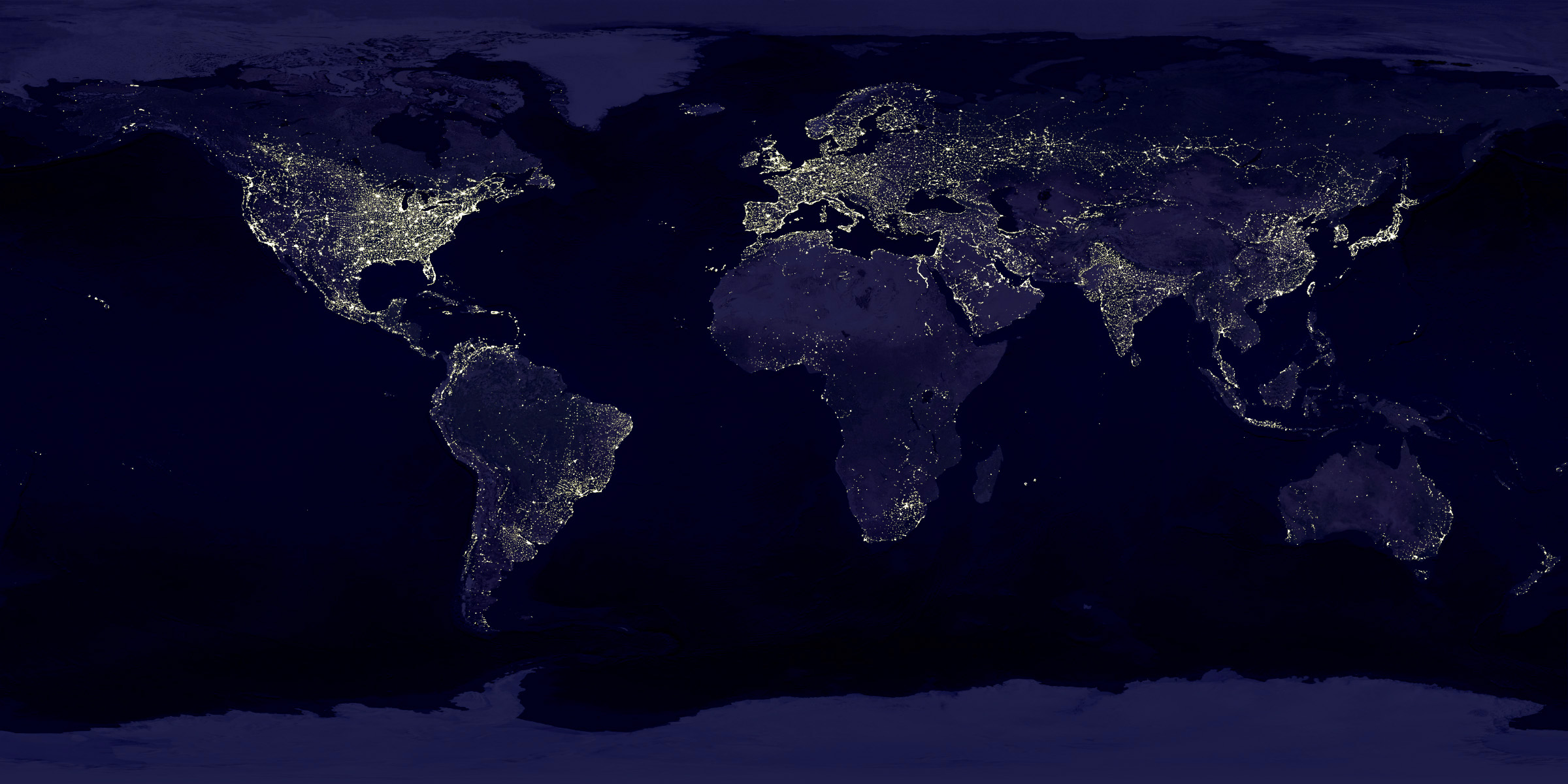
Regardless of how people feel on the development debate, the lights are mostly out across Africa. This map will show you. On average, only five percent of Africa’s population enjoys access to electricity. In rural areas, that number drops to about 2 percent.

A growing necessity
What may be seen as a luxury for home, electricity is a necessity for businesses. Machines or equipment can’t run without a current; nor can computers or lights. Cell phones won’t get charged.

What’s worrisome for entrepreneurs is not the lack of electricity, but an unstable electrical supply. When electricity is depended on, entrepreneurs embark in dangerous territory when the supply is cut or inconsistent. Stock could spoil; surges could damage machines; the workforce may be sent home without pay. The problem is that much of the continent’s manufacturing sector works in urban areas, and inconsistent electrical supplies in cities have become the norm. Growing metro regions sap a country’s electrical capability.

But in rural areas, where the possibilities of work outside of agriculture are minimal, a lack of electricity remains problem number one. Here is a good overview of small energy cooperatives making and selling power to everyday folks in rural Mali and Burkina Faso.

Resources, what resources?
On the macro level, however, Africa possesses enough resources to meet all its energy needs. Oil is a well known commodity. The continent’s fertile river systems – the Nile in the north, the Zambezi and Congo in the South and the Volta and Niger in West Africa – could easily be tapped for power. “The hydro potential of the Democratic Republic of Congo alone is estimated to be sufficient to provide three times as much power as Africa currently consumes,” writes Itai Madamombe in Africa Renewal, a UN-sponsored magazine.

West African energy production and consumption is a tale of the haves – Nigeria, Ghana, Cote d’Ivoire – and the have nots – Burkina Faso, Mali and Niger. For those three relatively poor Sahelian countries, located far from coastal energy producers, electricity is definitely viewed as a luxury. (My neighborhood not included.)

The problem appears to be two fold. Costs, for one: electricity in import countries like Burkina Faso and Mali can be prohibitively expensive for most people; Secondly, the reach of electrical utilities is low because of old power plants and aging equipment. This is a problem the entire sub-region and the rest of the continent, writes Madamombe in Africa Renewal:

The bulk of power plants and transmission facilities were built in the 1950s and 1960s. Little investment and maintenance has left the infrastructure creaking at the seams. Nigeria, a prime example, operates at one-third of its installed capacity due to aging equipment.

Times are changing, however. This recent report (cited above) on Independent Power Producers claims that people are willing to pay for electricity, but cannot receive it because of the limited reach of public utilities. The reach of these IPPs is, by definition, very limited: perhaps 50 to a couple hundred houses receiving energy. But their importance is staggering.

The writers have found that these local power supplies are, in fact, cheaper than using other forms of power. In the examples of Mali and Burkina Faso, running a single appliance costs around 1,500 CFA ($3.33) per month, cheaper than car batteries, which must be charged every three or four days, totaling nearly 4,000 CFA ($8.90) per month. (Car batteries also have a finite life span.)

Electricity Integration
Cote d’Ivoire, which already exports electricity to Togo, Benin and Burkina Faso, recently announced the creation of 500 km worth of power lines through the northern part of the country to Mali, where it will export 200 megawatts of electricity. The move is seen as a positive step not only for southern Mali’s development, but also for Cote d’Ivoire because the country was recently divided in two due to a prolonged civil war.

One problem facing the electricity project, which should be complete in 2010, is that Cote d’Ivoire itself is undergoing an expansion of its power grid at a time when consumption appears to be increasing faster than production. Cote d’Ivoire has long used gas-fired plants and dams to create power, but with the country’s consumption already increasing six or seven percent per year, blackouts like those witnessed in 2007 may become more common.

The Cote d’Ivoire-Mali project is part of a regional plan called the West African Power Pool, created in 2000 by the 15 ECOWAS-member states, that strives to increase power production and energy integration, allowing electricity to move freely across borders. This would allow countries to pool technical and mechanical resources and diversify everyone’s energy supplies. And, of course, hopefully bring down energy prices.

WAPP is also researching renewable energy sources, like wind, solar and biofuels.

$150 for Electric Company and Water Works?
One constant in West African power sectors is that the state remains a major player. Only Cape Verde and Cote d’Ivoire have portions of their sectors owned by foreign private companies, according to this report. And only Benin, Togo and Ghana allow independent distribution companies. (Presently, five countries permit IPPs: Burkina, Cote d’Ivoire, Ghana, Nigeria and Senegal.)

In a paper for the World Bank, a researcher argues the high rate of state ownership in West African public utilities takes away the profit motive to improve performance and “is liable to result in the excessive costs, low service quality, poor investment decisions, and lack of innovation in supplying customers in these markets.”

For governments that run their energy sectors, the only method to bring down electricity prices is by increasing user subsidies, never a popular method with World Bankers. The better way, researchers claim, is to allow private firms search out new markets they’ll find profitable, passing along savings to their customers. However, this group of researchers found that increased privatization in the energy sector has brought on greater rates of electrification for the poor, who often reside in rural areas. (The authors, Stephen Karekezi and John Kimani, argue electricity rates to the poor should drive the argument on the efficacy of reform.)

In defense of the World Bank paper, the author, John E. Besant-Jones, is less sanguine than you'd expect about developing countries jumping directly into reform. That’s because the power sector is unlike other areas of Bretton Woods-sponsored state retrenchment: Education and public health. One, the power sector is very complex, making highly technical specialists necessary; secondly, building new infrastructure requires a very large influx of cash. These reasons have led to failures (especially in the form of higher prices) when West African states have attempted to radically reform their energy sector.

Back to development
Because energy is so important for economic development, it is seen as a pre-requisite to lift many in Africa out of poverty. This is especially true for those who live in rural areas.

Presently, fossil fuels presently provide much of Africa’s energy consumption. Like Western countries, Africa needs to begin searching alternatives.

According to a speech at a workshop titled "Electricity Access and Development Challenge in Africa,” improved energy access will free up women’s time, reduce air pollution by moving away from burning charcoal and wood for cooking, thus improving health. (Girls not needed for collecting wood may find their ways back in the classroom.) Medical care will also be revolutionized, especially for maternal care, drug storage and increased sterilization.

For economic benefits, Africans could begin processing some of their many natural products – shea butter, cotton, palm oil, etc – that are made elsewhere to high profit margins.


Tuesday, November 6, 2007

Will Money Solve Africa’s problems?

Some time ago, the John Templeton Foundation asked development experts and their ilk the following question: Will Money Solve Africa’s problems?

It’s an important question, so I capitalized it, hoping it would be turned into a report of some sort. Anyway, of the eight responses so far, only two positive answers were yielded, a few emphatic negatives (including a “no way”), an “I thought so” and “only if.”

The question reminds me of the chicken-or-the-egg debate. You can endlessly discuss and dispute (and if the funds permit, perhaps hold a roundtable in a fancy Manhattan restaurant where lunch costs you half the GDP of Somalia). Part of me, however, says you’re not going to solve anything into you get yer butts out of the bistro (steal an ashtray, though, will you?) and bring a little concreteness to the proceedings. Instead of “Africa,” why not pose specific questions about “Rwanda” or “Congo Brazzaville” or “Niger.”

Speaking in the abstract sense, you can come up with all sorts of wacky plans and ideas. On the ground, however, we’re limited by reality. So let’s charter a plane to Zinder, Niger and hold a hearing. Now, that would be eye opening.

Another quibble. I understand the respondents know a bit about development, but how about actually asking someone who works in the field. My buddy Steve will talk for hours on the issue. Better yet, ask Africans – not only wildly successful ones, either – someone like Ahmed, this kid I know who sells phone cards at the end of the street. He’ll probably riff on your question forever. And he’s not the kind of guy who’d lift an ashtray.

The one good thing about these experts is that just because they’re not in the field so much, they definitely have their uses. These experts are good at speaking to each other without paying too much attention to the sounds us plebes make. It’s a good thing, really: these cats can really move the debate. We can only watch it moving.

Will Money Solve Africa’s Problems?

I thought so, says Michael Fairbanks, the co-founder of OTF Group, and the SEVEN FUND, which provides grants for enterprise solutions to poverty.

Every nation needs money to upgrade and improve the lives of their citizens; and it is good when a rich nation helps a poor one after a devastating act of God, or to meet a basic human need. But, too often, when one nation aids another it is based on a massive infusion of financial capital in return for changing monetary, trade, investment, fiscal, sectoral, and wage policies. This is often the right advice, but there is a trade-off, too. The nation with all the money often assumes the decision rights; and the responsibility for a nation’s future must always reside with the citizens of that nation, not with foreign advisors, and certainly not with its creditors and donors.

This sort of checkbook development confuses compassion and generosity with over-responsibility for fellow human beings. Explicitly or implicitly, the donor is telling them how to run their country, and in the process, without meaning to, can rob citizens of emerging nations of their most precious assets – dignity and self-reliance.

No, says Dr. Donald Kaberuka, president of the African Development Bank and formerly minister of finance of Rwanda.

Not as long as there are issues such as prolonged violent conflict, bad governance, excessive external interference, and lack of an autonomous policy space. Alone, money cannot solve Africa’s development problems. Proof, if any was needed, is the fact that many of Africa’s natural resource-rich countries score very low on human development indicators.
…

Africa must be given a chance to meaningfully integrate into the global trading environment in order to sustain growth performance. It will not happen if international commitments such as those made at the Gleneagles G 8 Summit are not met. The Doha Trade Round negotiations need to succeed. These negotiations have been called a Development Round because they frontload the interests of developing countries such as those in Africa. At the end of the day, we are all God’s children and he gave us one world in which we are interdependent.

Yes, says, Ashraf Ghani, chairman of the Institute for State Effectiveness. He was adviser to the UN for the construction of the Bonn Agreement for Afghanistan, and was finance minister of Afghanistan from 2002–2004.

If it is invested in enhancing African capabilities to integrate the continent into global networks of knowledge and creating prosperity and stability. This will mean confronting and overcoming a triple failure: corruption and abuse of power by African governments, predatory practices by extractive industries, and the waste of resources by an uncoordinated and ineffective aid system.

Africa will acquire a strong voice when it is represented by credible leaders and managers. Such people cannot be produced without investment in the appropriate institutions. Currently, about $5 billion per annum is provided in the form of technical assistance to meet donor requirements. Directing a significant portion of this money toward investment in institutions will produce stakeholders focused on creating a positive change.

No Way, says James Shikwati, founder and director of the Inter Region Economic Network and CEO of The African Executive business magazine.

The problem in Africa has never been lack of money, but rather the inability to exploit the African mind. Picture a banana farmer in a rural African village with a leaking roof that would cost $100 to fix. If one purchased $100 worth of his bananas, the farmer would have the power and choice to determine whether the leaking roof is his top spending priority. On the other hand, if he is given $100 as a grant or loan to fix the roof, his choice would be limited to what the owner of the big money views as a priority. Out of 960 million Africans in 53 states, there are innovators and entrepreneurs who, if rewarded by the market, will address the challenges facing the continent.

If money was the key to solving problems, banks would send agents on the streets to supply money to afflicted individuals. But banks only offer money to individuals who successfully translate their problems into opportunities. A $7 million British compensation to 228 Samburu herders in Kenya in 2002 did not stop them from turning into paupers by 2007. Money in itself is neutral. Big money viewed as capital has led strategists (who depict Africa as trapped in a cycle of poverty) to argue for massive inflows of money as the only means of escape from poverty. Viewing money as a receipt for value, a creation, and a resultant effect of exchange between different parties offers a chance to translate African problems into opportunities.

I think you get what I say about the abstract. Any idea will work, especially when you’re only allotted 350 words. The good folks at the John Templeton Foundation society also asked William Easterly his thoughts on the issue, but I already give him enough press – not that I don’t agree with him.

I am all for changing the system of development; in the macro sense, it surely doesn’t appear to be working. But are we pinning too much hope on the business class around these parts? On one level, that’s a good thing – it’s better than waiting for your average functionnaire to get out from behind his desk.

My question is whether the business sector is ready for it. As my wife says, “I don’t mean to be mean” but there’s a lot of hurdles to cross before professionalism sets in. We are living in a time where factories in Asia produce “African” masks because the Asian-produced goods arrive on time, aren’t full of mistakes and are cheaper for stores in Europe to buy. Add on to that heavy transportation costs, and Africa surely feels further apart from the rest of the world than ever.